
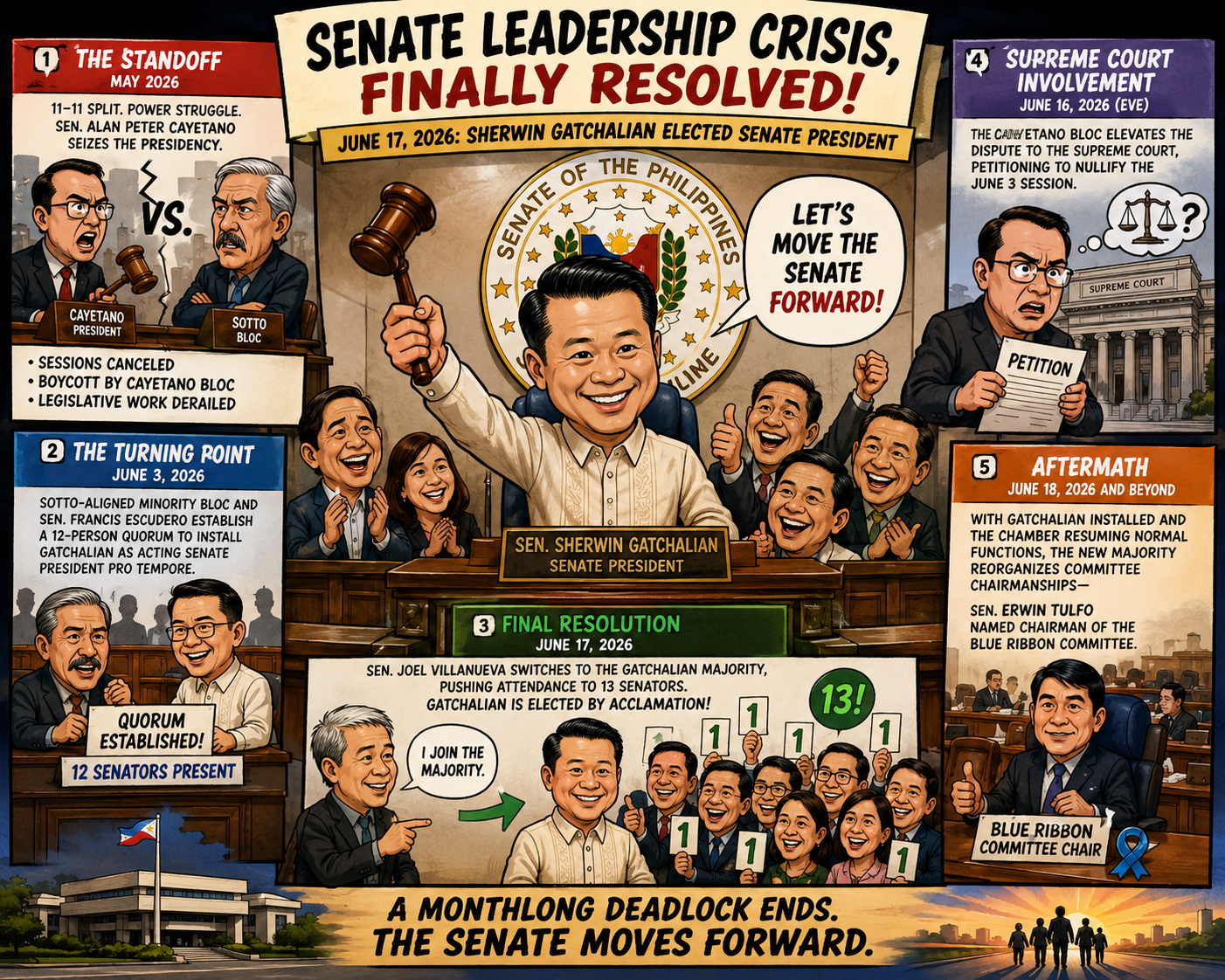

MANILA — The Philippine Senate presents itself as the country’s premier deliberative chamber—an institution built to withstand political storms while continuing to legislate. But recent leadership turmoil suggests a different reality: one marked by fractured alliances, stalled lawmaking, and an estimated P700 million price tag for institutional paralysis.
Senator Panfilo “Ping” Lacson’s estimate that nearly P700 million was spent during 28 days of instability under former Senate President Alan Peter Cayetano is more than political commentary. Whether taken as precise accounting or an illustrative figure, it raises a broader question: what does institutional dysfunction cost the public?
The leadership crisis began when Cayetano secured the Senate presidency following a contentious reshuffling of alliances. Critics and political observers, however, point to a more complex power realignment behind the scenes—one that reportedly included the consolidation of a 13-member majority through the return of Senator Ronald “Bato” dela Rosa after months of absence amid ICC-related concerns. In political circles, this move was viewed by some as decisive in tipping the balance that unseated then Senate President Tito Sotto.
According to the same narrative circulating in the “grapevine,” that consolidation was not merely about internal Senate leadership, but also about positioning ahead of the politically charged environment surrounding Vice President Sara Duterte’s anticipated impeachment proceedings or trial—claims that remain unverified but continue to shape how that period is interpreted in hindsight.
What followed was not routine transition but fragmentation. The Senate became split into competing blocs, with leadership disputes spilling into daily proceedings. Quorum became uncertain, sessions were disrupted, and legislative work slowed as rival groups refused to fully recognize each other’s authority.
At times, the chamber functioned as two competing centers of power, with procedural battles overshadowing urgent national legislation. Instead of focusing on governance, the Senate became consumed by questions of legitimacy and control.
The eventual resolution—secured only after a decisive shift in numbers during a special session—restored order. But it also left lingering questions about how quickly institutional stability can unravel when leadership is built on fragile political coalitions.
Lacson’s estimate, based on an operating cost of roughly P25 million per day, gives a concrete figure to that instability. Even if debated, the broader point remains: public funds continue to be spent regardless of whether the Senate is functioning efficiently or locked in internal conflict.
The issue, however, goes beyond personalities like Cayetano, Sotto, or Lacson. It is structural. The Senate is designed to deliberate, not deadlock—yet shifting alliances repeatedly expose it to paralysis that slows lawmaking and weakens governance.
Defenders of political realignments argue that they are part of democratic practice in a multiparty chamber. That is true—but democracy does not require paralysis, nor does it require governance to be repeatedly disrupted by internal power struggles with real fiscal consequences.
The question is not who prevailed in any single leadership contest, but whether the institution can shield its core functions from political turbulence that carries both legislative and financial costs.
If Lacson’s figures are even partly accurate, the cost of instability is not symbolic—it is tangible, recurring, and ultimately borne by taxpayers. More importantly, it challenges the Senate to ensure that leadership disputes do not come at the expense of governance itself.
Because in the end, the Senate’s credibility is measured not by who holds the gavel, but by how effectively it works while they do.
NEW SENATE LEADERSHIP AND COMMITTEE REORGANIZATION
Following a special session formalizing the election of Senator Sherwin Gatchalian as Senate President, the chamber moved swiftly to restore full functionality through a wide-ranging committee reorganization.
The powerful Committee on Accountability of Public Officers and Investigations (Blue Ribbon Committee) was reconstituted with 17 regular members and three ex-officio members under an 11–9 majority-minority arrangement. Senator Erwin Tulfo was elected chair, with Senators Francis Pangilinan and Panfilo Lacson as vice chairpersons.
A broader reshuffle of committee leadership followed. Tulfo also took over the Energy and Social Justice committees. Pangilinan was named chair of Constitutional Amendments, Justice, and Agriculture. Senator Bam Aquino was assigned Trade, Basic Education, and Science and Technology, while Senator Risa Hontiveros assumed leadership of the Health and Women and Children panels.
Senator JV Ejercito was appointed chair of Finance and Local Government, while Senate President Pro Tempore Vicente Sotto III led National Defense and Ethics. Zubiri chaired Foreign Relations and Rules, Lacson headed Ways and Means, Raffy Tulfo led Public Services and Migrant Workers, Manuel Lapid took Games and Amusements, and Joel Villanueva was named chair of Higher Education and Labor.
Vice chairmanships were also distributed, with Ejercito assigned to multiple committees including Energy, Agriculture, Health, and National Defense, while Aquino was named vice chair of Ways and Means and Public Services.
The Senate also finalized its representation to key constitutional bodies. Lacson, Zubiri, Villanueva, Hontiveros, Sotto, Raffy Tulfo, and Ejercito were elected to the Commission on Appointments. Aquino, Pangilinan, Lapid, and Francis Escudero were selected for the Senate Electoral Tribunal, while Pangilinan was designated Senate representative to the Judicial and Bar Council.
Key chamber leadership posts were likewise confirmed, with Ejercito serving as senior deputy majority leader and Villanueva as deputy majority floor leader under Majority Leader Juan Miguel Zubiri.
With the reorganization completed without objection, the Senate signaled a return to full legislative work after weeks of internal deadlock.