

For years, education has been promoted as one of the foundations of peace and development in the Bangsamoro Autonomous Region in Muslim Mindanao (BARMM). But despite billions of pesos being allocated to the sector, many indicators suggest that meaningful progress remains painfully slow.
The Ministry of Basic, Higher, and Technical Education (MBHTE) reportedly manages the largest portion of BARMM’s regional budget, with ₱26.49 billion allocated for education programs. In theory, such a large investment should translate into improved schools, better teachers, and stronger learning outcomes. Yet persistent reports of delayed implementation and slow fund utilization continue to cast doubt on whether the system is functioning effectively.
Government inefficiency is not simply a technical issue. In education, delays can directly affect students waiting for classrooms, teachers needing support, and communities hoping for better opportunities. Every postponed project or unused allocation represents time and resources lost.
The reported functional illiteracy rate of 38.3% remains one of the clearest signs that serious problems persist. Compared to the national average, the figure suggests that many learners in BARMM are still struggling to develop basic literacy skills despite years of educational investment and reform efforts.
Teacher preparedness is another concern that deserves attention. BARMM’s low ranking in licensure examinations reportedly reflects continuing weaknesses in teacher development and academic preparation. No education system can succeed without competent and adequately supported educators inside the classroom.
Meanwhile, higher education continues to face major challenges. Reports of dropout rates reaching as high as 90% and enrollment participation remaining below national levels reveal a system that many students fail to enter—or fail to remain in. These numbers suggest that financial investment alone is not enough to address the deeper barriers affecting access to education.
Infrastructure problems also remain difficult to ignore. Several school projects reportedly remain unfinished, while shortages in learning materials and classroom resources continue to affect students in different areas. Critics argue that the presence of unused funds despite these shortages points to serious weaknesses in planning and implementation.
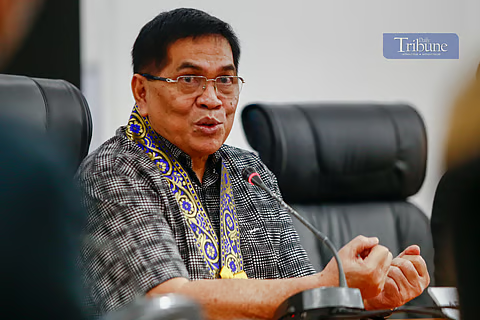
The leadership transition within MBHTE may create hopes for reform, but expectations should remain realistic. Without major improvements in governance, budgeting, and monitoring mechanisms, changes in leadership risk becoming symbolic rather than transformative.
BARMM now faces an important moment. The conversation should no longer focus solely on how much funding is being allocated to education. What matters most is whether those resources are producing measurable improvements in literacy, teacher quality, school infrastructure, and student success.
Until stronger results become visible on the ground, public scrutiny over BARMM’s education system is unlikely to fade.
On May 18, 2026, Abdulraof Macacua relieved Mohagher Iqbal of his duties as Minister of Basic, Higher, and Technical Education (MBHTE) due to an alleged loss of trust and confidence. The move came amid reported irregularities involving ₱2.2 billion allocated for education funds.